Frequency spectrum of a sine-wave tone burst
Sine-wave tone burst
A sine-wave tone burst signal is shown in Figure 1.
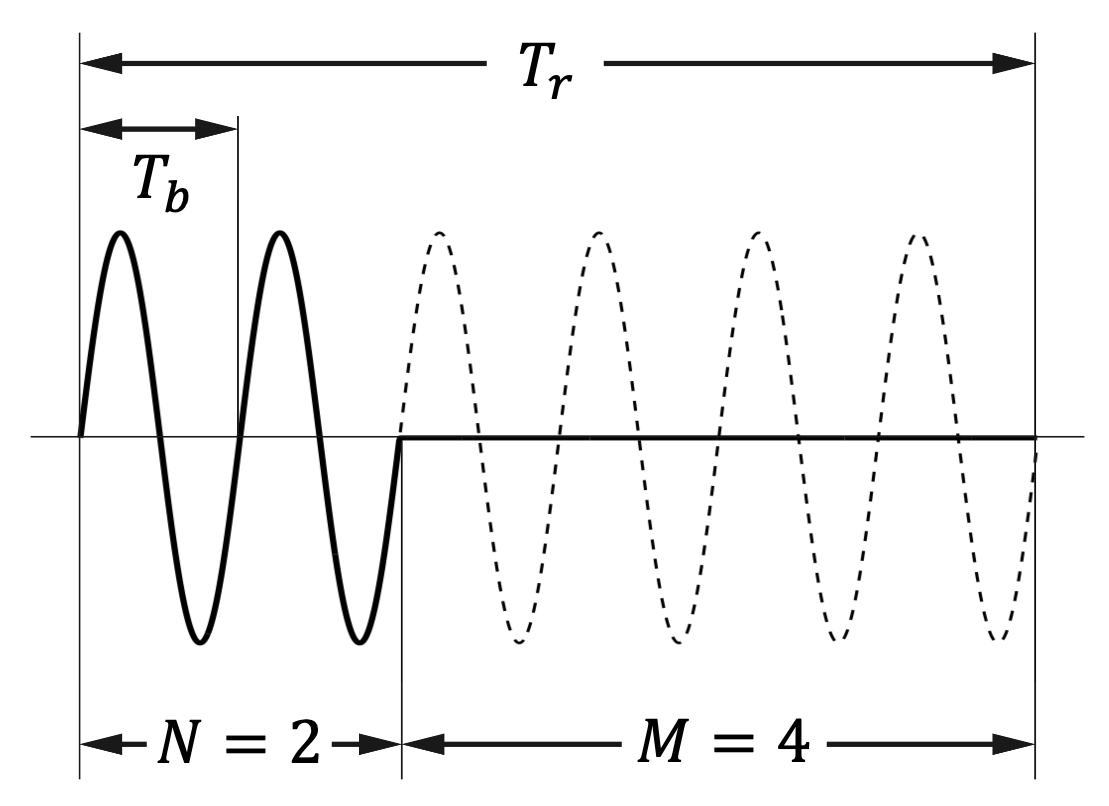
It is formed by “turning on and off” (gating) a sinusoidal signal (here). The sinusoidal signal, with fundamental period \(T_b\) (frequency: \(f_b = 1/T_b\)) and initial phase \(\theta_b\), is assumed here to have unit amplitude:
\[ x_b(t)=\sin\left(2\pi\dfrac{t}{T_b}+\theta_b\right) \]
Gating amounts to multiply it by \(x_p(t)\), which can be described as the time-delayed rectangular function \(\text{rect}(t/T_g)\), periodized by the fundamental period \(T_r\):
\[ x_p(t)=\sum_{n=-\infty}^{+\infty}\text{rect}\left(\dfrac{t-\tau_r-nT_r}{T_g}\right) \]
where \(\tau_r\) is the time-shift of the rectangular function before submitting it to periodization. Henceforth, we assume that \(T_r>T_b\), and a multiple integer of full cycles of \(x_b(t)\) is captured in either the time interval \(T_g\) or the time interval \(T_r\): in Figure 1, \(T_g=2T_b\) (\(N=2\)) and \(T_r=6T_b\) (\(M=4\), hence \(N+M=6\)).
The rectangular function (also known as the rect function, gate function) is defined as:
\[ \text{rect}\left(\dfrac{t}{T}\right)=\left\{ \begin{align} 1,&\quad\vert t\vert\leq T/2\\ 1/2,&\quad t=T/2\\ 0,&\quad t>T/2 \end{align} \right. \]
The Continuous Time Fourier Transform of the rectangular function \(\text{rect}(t/T)\) is:
\[ X(f)=T\,\text{sinc}(fT) \]
In digital signal processing and information theory, the sinc function is commonly defined for \(x\neq0\) by
\[ \text{sinc}(x)=\dfrac{\sin(\pi x)}{\pi x} \]
The duty-ratio factor is defined as the ratio of time the tone is ON compared to the total time when it is either ON or OFF, namely \(D=N/(N+M)=N/L\). The duty-ratio factor approaches 0 for widely spaced, narrow bursts or 1 for closely spaced, wide bursts: when \(D=1\), \(x_r(t)=1\) and \(x(t)=x_b(t)\) (pure sine-wave).
When the duty-ratio factor is a rational number, the sine-wave tone burst \(x(t)\) can be modeled as the product of two periodical signals, namely \(x_b(t)\) (with period \(T_b\)) and \(x_r(t)\) (with period \(T_r\)):
\[ x(t)=x_r(t)\cdot x_b(t) \]
The fundamental period of \(x(t)\) is \(T=T_r\). We can appropriately choose the phase shift \(\theta_b\) and the time delay \(\tau_r\) so as to yield a signal \(x(t)\) without discontinuities and further endowed with odd symmetry (e.g., \(\theta_b=0\), \(\tau_r=0\)). Under these conditions, \(x(t)\) can be regarded as composed by infinitely many replicas (with period \(T_r\)) of the time-limited signal \(x_p(t)\):
\[ x_p(t)=\left\{ \begin{align} \sin\left(2\pi\dfrac{t}{T_b}\right),&\quad\vert t\vert\leq T_g/2\\ 0,&\quad\text{elsewhere} \end{align} \right. \]
Fourier analysis
The Fourier series of \(x(t)\) is defined as a trigonometric series of the form:
\[ x(t)=A_0+\sum_{n=1}^{+\infty}A_n\cos\left(2\pi \dfrac{n}{T_r}t\right)+\sum_{i=1}^{+\infty}B_n\sin\left(2\pi \dfrac{n}{T_r}t\right) \]
where the Fourier series coefficients are defined by the integrals:
\[ \left\{ \begin{align} A_0&=\dfrac{1}{T_r}\int_{-T_{r}/2}^{T_{r}/2}x(t)\,dt\\ A_n&=\dfrac{2}{T_r}\int_{-T_{r}/2}^{T_{r}/2}x(t)\cos\left(2\pi\dfrac{nt}{T_r}\right)\,dt\\ B_n&=\dfrac{2}{T_r}\int_{-T_{r}/2}^{T_{r}/2}x(t)\sin\left(2\pi\dfrac{nt}{T_r}\right)\,dt \end{align} \right. \]
Since \(x(t)\) is odd-symmetric, \(A_0\) is null (i.e., the sine-wave tone burst has no DC component) and \(A_n=0,n=1,\cdots,+\infty\). The harmonic coefficients \(B_n\) are given by:
\[ B_n=\dfrac{4}{T_r}\int_0^{T_g/2}\sin\left(2\pi\dfrac{t}{T_b}\right)\sin\left(2\pi\dfrac{nt}{T_r}\right)dt \]
where \(T_r=LT_b\) (\(L=N+M\)) and \(T_g=N T_b\). To make the notation lighter, \(T_b=T\) in the following. The spectrum of the sine-wave tone burst requires the calculation of the Fourier integrals:
\[ B_n=\dfrac{4}{LT}\int_{0}^{N T/2}\sin\left(\dfrac{2\pi}{T}t\right)\sin\left(\dfrac{2\pi}{T}\dfrac{n}{L}t\right)dt \]
The Werner formulas are the trigonometric product formulas:
\[ \begin{align} 2\sin\alpha\cos\beta&=\sin(\alpha-\beta)+\sin(\alpha+\beta)\\ 2\cos\alpha\cos\beta&=\cos(\alpha-\beta)+\cos(\alpha+\beta)\\ 2\cos\alpha\sin\beta&=\sin(\alpha+\beta)-\sin(\alpha-\beta)\\ 2\sin\alpha\sin\beta&=\cos(\alpha-\beta)-\cos(\alpha+\beta) \end{align} \]
Applying the Werner formulas, the integrand can be written:
\[ \sin\left(\dfrac{2\pi}{T}t\right)\sin\left(\dfrac{2\pi}{T}\dfrac{n}{L}t\right)=\dfrac{1}{2}\left[\cos\left(\dfrac{2\pi}{T}\left(1-\dfrac{n}{L}\right)t\right)-\cos\left(\dfrac{2\pi}{T}\left(1+\dfrac{n}{L}\right)t\right)\right] \]
Therefore:
\[ \begin{align} B_n &= \dfrac{2}{LT}\dfrac{1}{\dfrac{2\pi}{T}\left(1-\dfrac{n}{L}\right)}\sin\left(\dfrac{2\pi}{T}\left(1-\dfrac{n}{L}\right)t\right)\biggr\vert_0^{NT/2}\\ &-\dfrac{2}{LT}\dfrac{1}{\dfrac{2\pi}{T}\left(1+\dfrac{n}{L}\right)}\sin\left(\dfrac{2\pi}{T}\left(1+\dfrac{n}{L}\right)t\right)\biggr\vert_0^{NT/2} \end{align} \]
and
\[ \begin{align} B_n &= \dfrac{2}{\pi L}\dfrac{1}{\left(1-\dfrac{n}{L}\right)}\sin\left(\pi N\left(1-\dfrac{n}{L}\right)\right)-\dfrac{2}{\pi L}\dfrac{1}{\left(1+\dfrac{n}{L}\right)}\sin\left(\pi N\left(1+\dfrac{n}{L}\right)\right)\\ &=\dfrac{N}{L}\left[\text{sinc}\left(N\left(1-\dfrac{n}{L}\right)\right)-\text{sinc}\left(N\left(1+\dfrac{n}{L}\right)\right)\right] \end{align} \]
Using the duty-ratio factor, we have:
\[ B_n=D\left[\text{sinc}(D(L-n))-\text{sinc}(D(L+n))\right] \]
When \(D=1\) (i.e., \(x_r(t)=1\)), we get \(B_n = 0\) for all \(n\), but \(B_L=1\). Recall that the \(L\)th harmonic component in the spectrum of \(x(t)\) corresponds to the fundamental frequency of the sine-wave, \(f_b\) - as noted above, if \(x_r(t)=1\), then \(x(t)=x_b(t)\). For any value of \(D\) different from 1, the maximum value of \(B_n\), \(B_{\text{max}}=D\) still occurs when \(n=L\), however other lines are present in the spectrum. These lines are at the (analog) frequencies \(f_n=f_b+(n-L)f_r\).
Examples
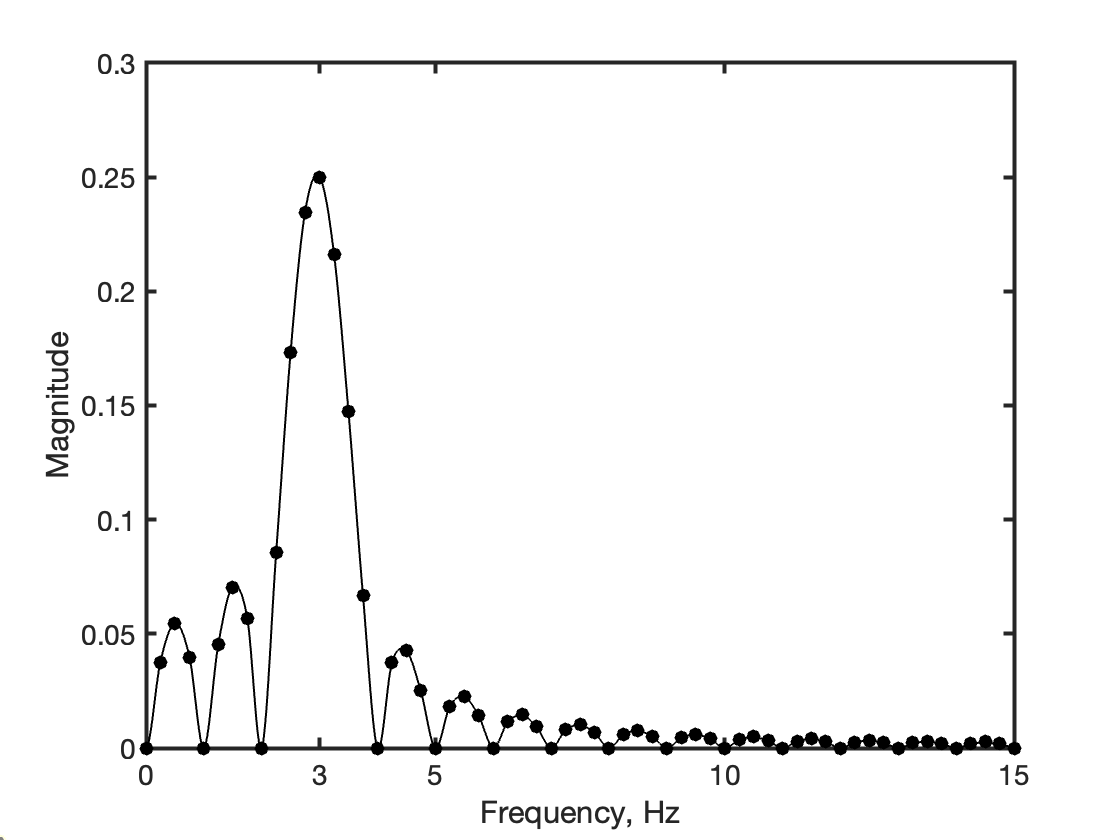
A sine-wave tone burst with duty-ratio factor \(D=0.25\) (\(f_b=3\,\text{Hz},f_r=0.25\,\text{Hz},T_b=1\,\text{s}\)) was simulated in MATLAB. The sampling frequency chosen for the simulation was \(f_s=80\,\text{Hz}\). The Fast Fourier Transform (FFT) algorithm was applied for spectrum computation. The guidelines discussed in one previous post of mine (here) were followed to prevent spectral leakage and amplitude ambiguity. Superimposed on the values computed by the FFT (solid black points) is the envelope obtained by interpolating the discrete spectrum \(B_n\) (see above), Figure 2.
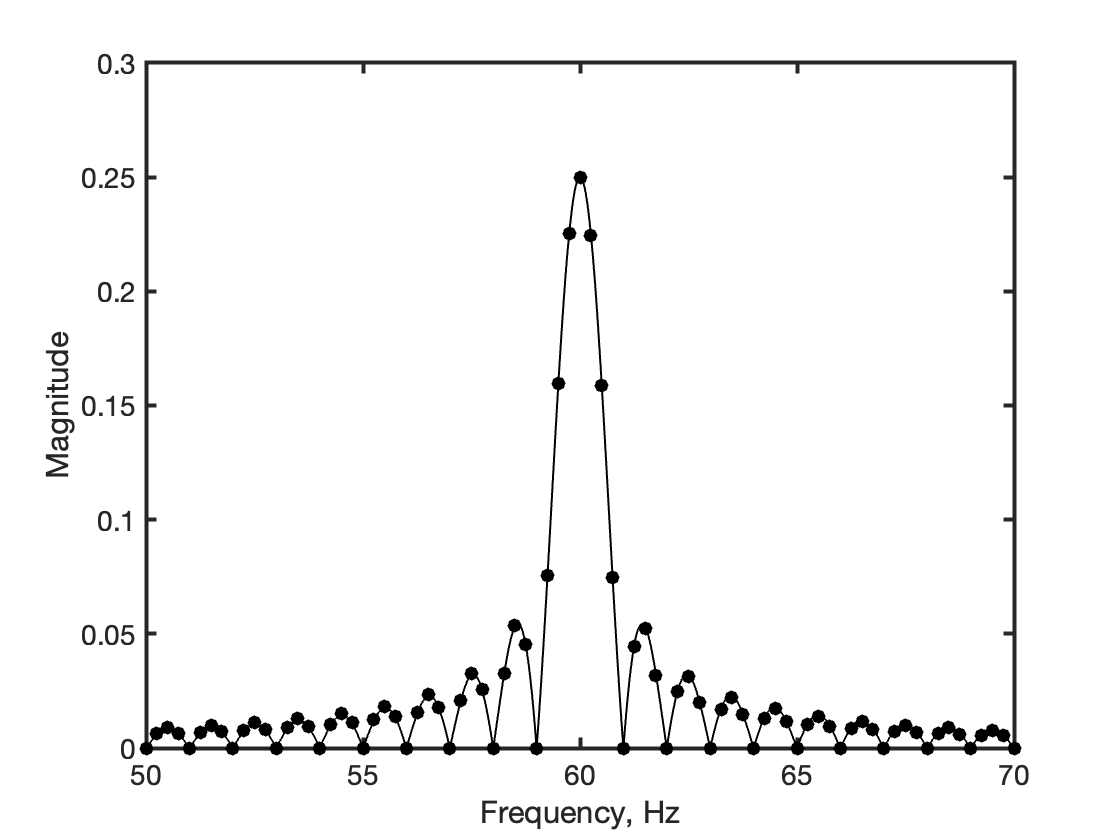
The MATLAB code was run again in a scenario where the frequency of the sine wave moved up to \(f_b=60\,\text{Hz}\), with a corresponding adjustment of the sampling frequency (\(f_s=800\,\text{Hz}\)). The results of the FFT-based spectrum analysis are reported in Figure 3.
The FFT-based spectrum can be also interpreted as the outcome of the following cascaded frequency-domain signal-processing operations:
frequency sampling the spectrum \(T_g\,\text{sinc}(f\,T_g)\) - this is explained by the time periodization of the rectangular function \(\text{rect}(t/T_g)\) with period \(T_r\).
frequency shifting the frequency-sampled spectrum - this is explained by the amplitude modulation impressed on the periodized rectangular function when the latter is multiplied by the sine wave at frequency \(f_b\).